Marronnier Open
Music Studio
Typology
Renovation / Community Center
Location
Hyehwa, Seoul, South Korea
Date
Spring 2022
Philosophy
Renovation of colonial remnant into music production and performing art center
Designer
Jaeseo Choi
Studio
Professor
Studio III - Korea University
Santiago Porras Alvarez
Nestled in the heart of Hyehwa-dong, Seoul, South Korea, the Marronnier Open Music Studio breathes new life into the former Seoul National University Headquarter Building, a historical gem dating back to the 1920s. The project combines the restoration of a culturally significant architectural landmark with the creation of a vibrant community center, music performance and recording studio, and urban design masterpiece. Situated in the lively Marronnier Square, a hub of artistic expression and youthful energy, this renovation project pays homage to the building’s rich history while nurturing the creative spirit of the surrounding area.
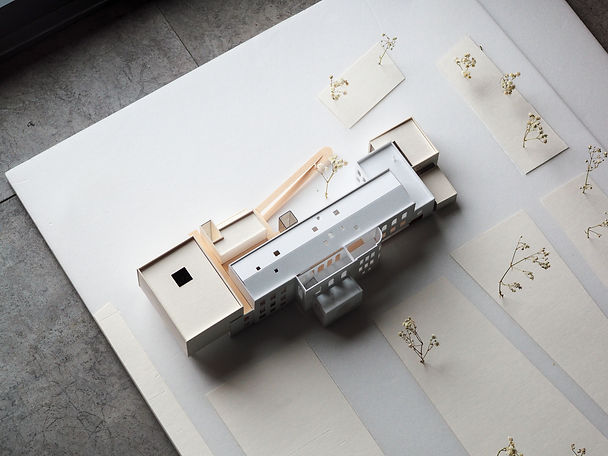
The project’s foundations were laid through an in-depth analysis of the site’s building plans and facades, as well as a study of the renowned architect Park Gil Ryong. This exploration revealed the architect’s masterful use of well-balanced compositions, incorporating squares and cubes to create an overall harmonious structure.


The design concept utilized Park Gil Ryong’s square/cube composition as a starting point, expanding upon it with thoughtful additions. The extensions primarily took place on the south side, carefully designed as minimal boxes that complemented the original building’s geometry. Within these simplified box structures, organic interior walls were integrated, serving as both visual indicators of creative spaces and effective acoustic treatments for the recording studios.
At the heart of the Marronnier Open Music Studio lies a majestic void space within the main building - a communal area that fosters social interactions and serves as a prelude to performances. This awe-inspiring interior doubles as a lobby, facilitating meaningful interactions between artists and locals.


The interface between the original building and the extensions serves as transitional zones while providing ample daylighting and circulation paths. This separation not only enhanced structural integrity but also ensured proper sound isolation between each recording space.
Additionally, the project included a meticulous revamp of Marronnier Square. By leveraging the entrances of the new music studio building, neighboring structures, and adjacent alleyways, circulation paths were reorganized with minimal axes. Some of these axes even penetrated the ground floor of the music studio building, seamlessly leading visitors through a sculptural ramp in the southern courtyard.

The Marronnier Open Music Studio is not merely a renovation project; it represents a celebration of history, creativity, and community. By preserving the architectural heritage of the former SNU HQ and infusing it with a dynamic and inclusive music studio, this endeavor honors the past while providing a platform for artistic expression and engagement. It is a testament to the transformative power of architecture, cultivating connections between the past, present, and future, and invigorating the vibrant cultural tapestry of Hyehwa-dong.